Best Apps of July
TikTok reading, the flip side of privacy, and 'Black Mirror'.
Lately I've caught myself thinking that I'm turning my blog into a hoarder's warehouse, except instead of old stuff, I'm collecting apps that I plan to write about.
At the beginning of this year, I released an article with my personal wrap-up and awards for the best apps. Thank you so much for your feedback! I realized that it's an excellent tool for drawing a line under things, and we're definitely keeping it in mind.
But doing such roundups once a year is criminally rare, isn't it? So to cut down the wait time, let's mix things up with a short issue about the interesting apps of the month. All the apps featured below are completely free.
Stasis: RSVP Speed Reader
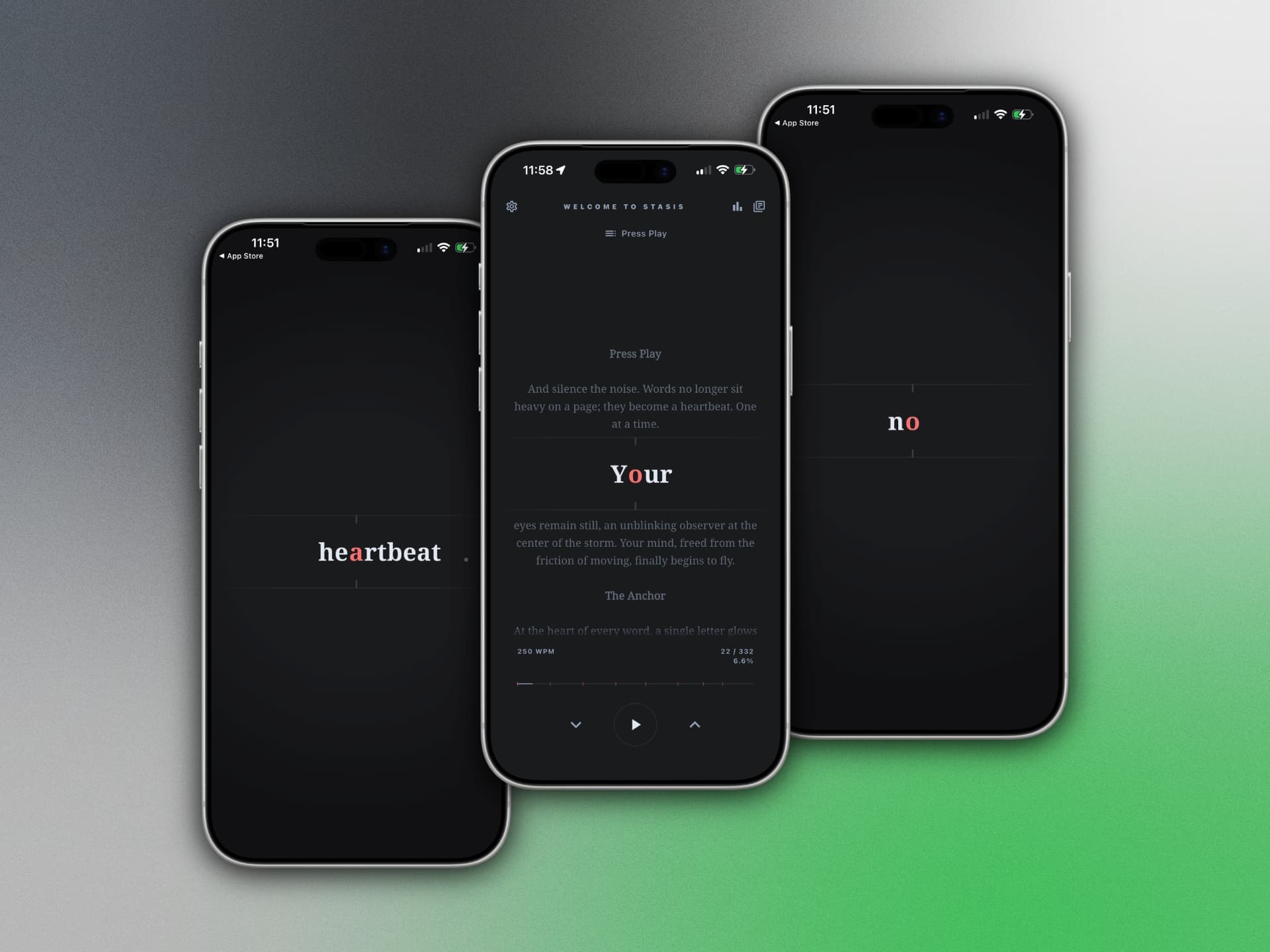
A speed-reading app that displays text strictly one word at a time in a fixed spot on the screen. The method is called RSVP (Rapid Serial Visual Presentation). For myself, I've dubbed it 'TikTok reading': you just stare at one single point, and the content flies right into your brain without any extra eye movements. The app easily processes EPUB, PDF, and plain text, handling everything from a moderate 50 to an extreme 1,000 words per minute within a highly minimalist interface. It makes micro-pauses on punctuation and long words to keep the reading smooth rather than turning it into mush.
How useful is this in practice? Of course, the RSVP method works. Studies show that reading speed increases by an average of 30-40% with it. The secret is simple: words flash in the exact same place, which completely eliminates saccades (I came across this French word in the App Store description, absolutely loved it, and went to Google what it means - it refers to the micro-movements of the eyes). As a result, your gaze doesn't wander around the screen, focus sharpens, and time is saved.
But such a cheat code comes with an obvious trade-off. At high speeds, comprehension of complex texts drops rapidly, and for serious literature, the classic static format is still irreplaceable. On top of that, prolonged surfing in RSVP mode significantly strains the eyes and overheats the brain.
If you need to quickly swallow a mountain of simple texts, short notes, or small articles, this app will be a great helper. If, however, you have deep studying ahead, complex technical long-reads, or something similar, good old classic reading hasn't been beaten yet.
Loupe
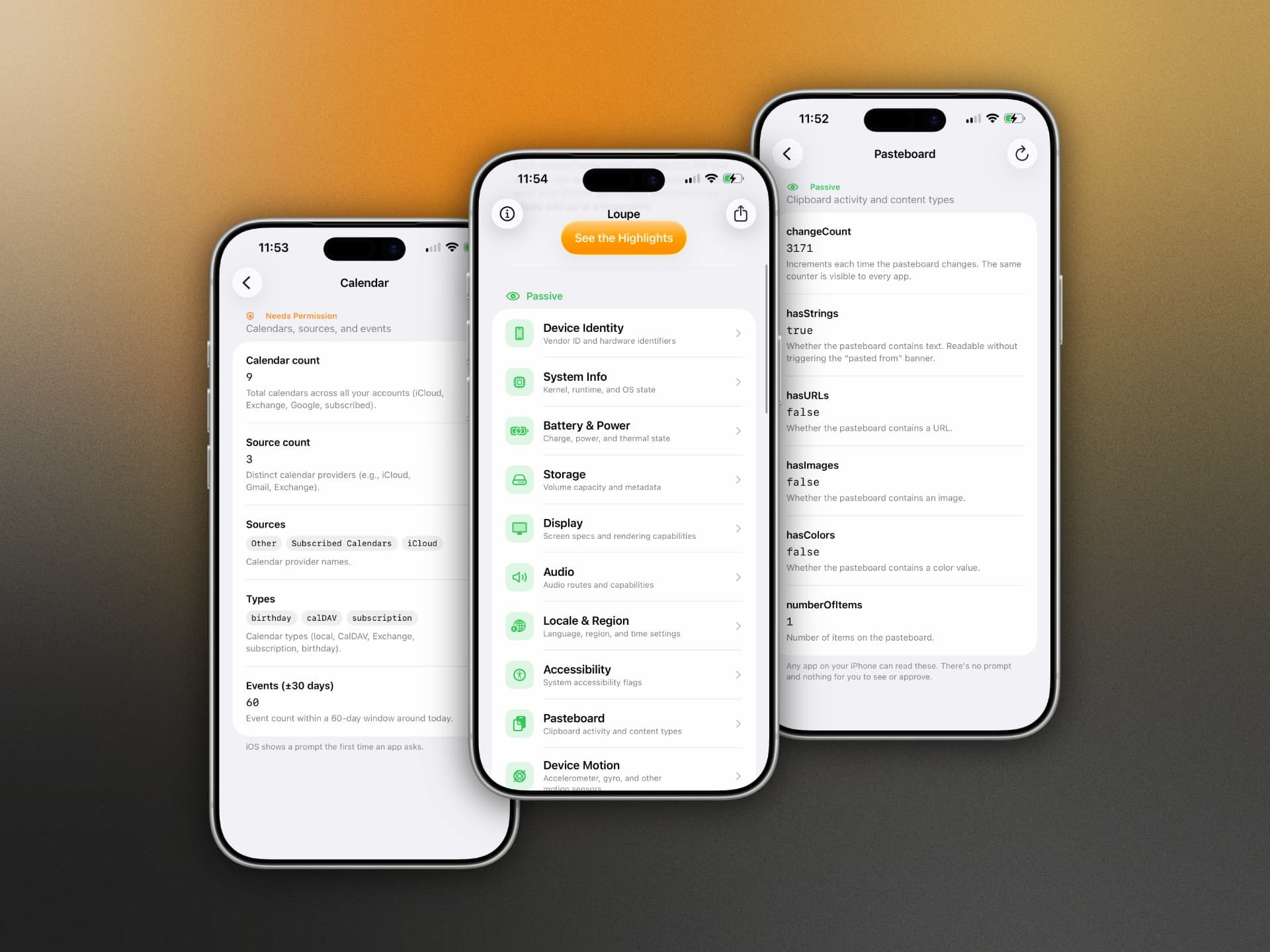
An incredibly addictive piece of software for those who want to look under the hood of Apple's privacy. Loupe clearly demonstrates exactly what data and signals from your iPhone can be legally read by any ordinary app through iOS public APIs.
All the information in the utility is divided into three distinct levels:
- Passive data - the kind that flies off to developers without any requests or pop-up windows whatsoever.
- Data on request - things that require your official permission in iOS (location, photos, etc.).
- Advanced signals - technical markers through which software can collect a digital fingerprint of your device for hidden tracking.
What's more, Loupe doesn't just dump dry logs on you; it explains thoroughly and in plain terms exactly what you are sharing with every downloaded app in the background.
An important nuance: this isn't real-time monitoring of other programs, but simply an interactive demonstration of the privacy surface area. It shows just how much interesting stuff software can find out about your region, battery status, screen parameters, network environment, and a bunch of other hidden variables.
In short, an indispensable utility for broadening your horizons. After five minutes (who am I kidding, I sat there for way longer) in Loupe, you start treating your digital hygiene much more mindfully and think twice before granting yet another app yet another 'allow'.
Rewind: Audio Rewind of Life
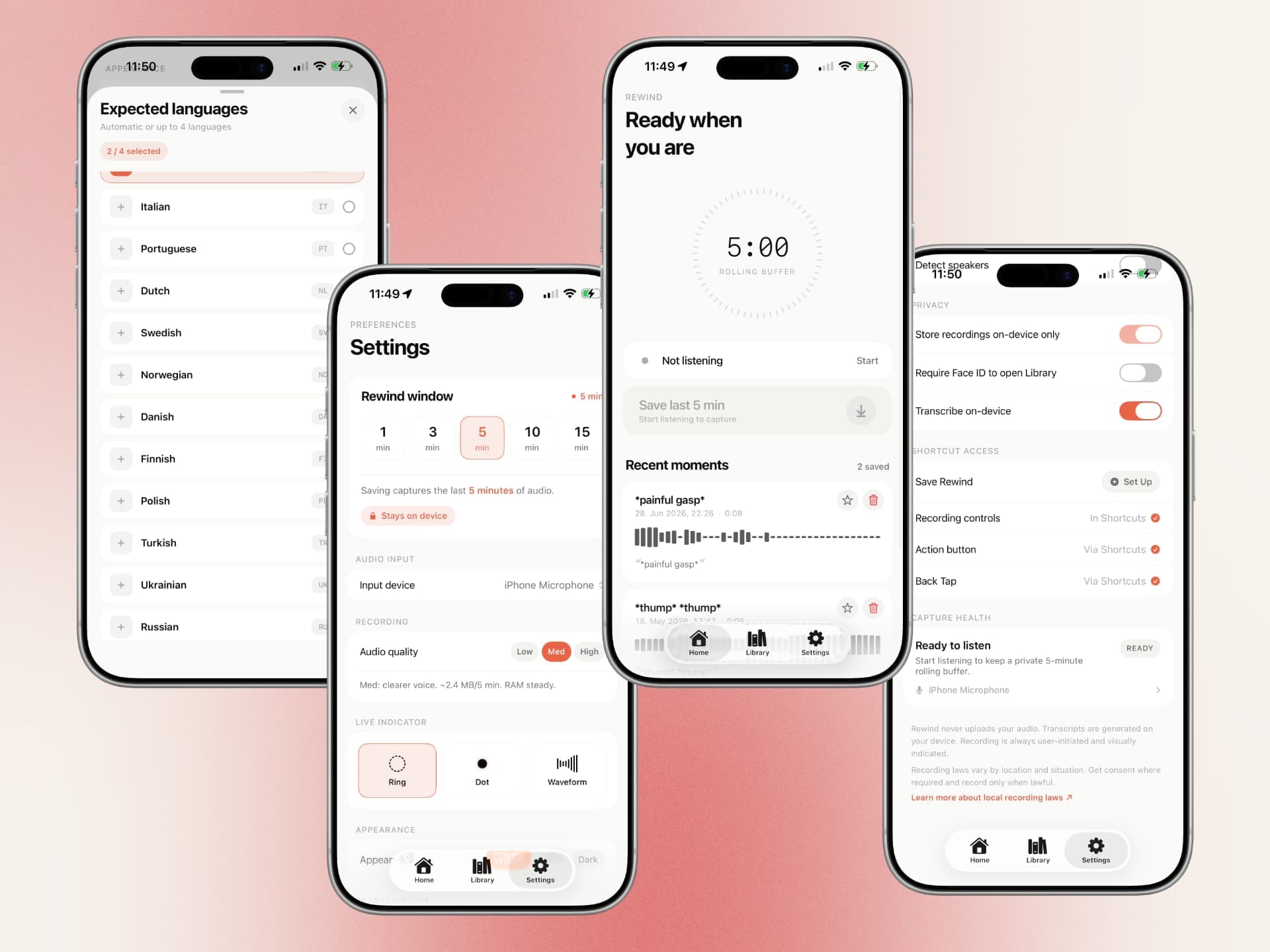
We've been living in 'Black Mirror' for a while now. Remember the episode where the characters could rewind memories and even display them on a screen? Well, on New Year's Eve, I sat there thinking: damn, how cool would it be to have an app like that in real life, so you could at least rewind the audio and listen to where you tuned out at a vital moment.
I mean, picture a classic situation: you meet someone, they extend a hand and say, 'Hi, my name is... Shhh-shhh-shhh.' A minute passes, you need to address them, but there's nothing but white noise in your head. You try to remember... and absolutely nothing.
And now, cut and rewind time back. The exact same situation, except after listening, you pull out your phone, tap the screen (you can configure how to do this), and save the buffer of the last five minutes. You listen and clearly hear: 'My name is Maximilian.' A lifesaver. Now you can address him by name, and he'll appreciate it.
Or another scenario: your head is splitting at work, a colleague is dictating critical edits to a project, and you are just physically incapable of processing the information. Instead of asking again and spacing out, you save the slice of conversation post-factum and quietly relisten to it once you crawl your way to a pill and coffee.
Rewind is an audio-rewinding app for iPhone. It constantly listens to the background and stores a short rolling buffer (the last 1, 3, 5, 10, or 15 minutes). The idea is that you aren't recording gigabytes of junk in a row, but rather extracting an important moment after it has already happened. It's absolutely perfect for the Action Button.
Rewind cyclically overwrites the sound in the buffer. As soon as you hit Save, the app compiles the audio clip, saves it to your library, and instantly generates a text transcript, a brief summary, and even timecodes with speaker labels. And here's a life hack for those who still have the silent mode toggle on their Action Button: you can map the save action to the Action Button and rescue slipping information with a single press (shortcuts and Siri are also supported here).
As for privacy, everything is fine here, the app requires no accounts, clouds, or servers. Everything runs locally on the iPhone in an isolated sandbox. All the magic of transcription and AI summaries happens right on the device's chip (the language model is downloaded from the network only upon the first launch). That's iOS protection in action.
Of course, this isn't an everyday voice recorder, but simply a private audio assistant with delayed saving. First, you live the moment, and then you decide if it was worth remembering. Waiting for the day a chip comes along so we can save video too, just like in 'Black Mirror'.
P.S. As it turns out, even in the era of total vibe-coding, you can still find good, human-written apps. And for that, you don't necessarily have to sign up for yet another $4.99/month subscription - yes, indie developers still know how to surprise us out of pure enthusiasm, rather than just serving wrapped-up prompts.
Hommage
Reboot, or How I Stopped Coding Articles